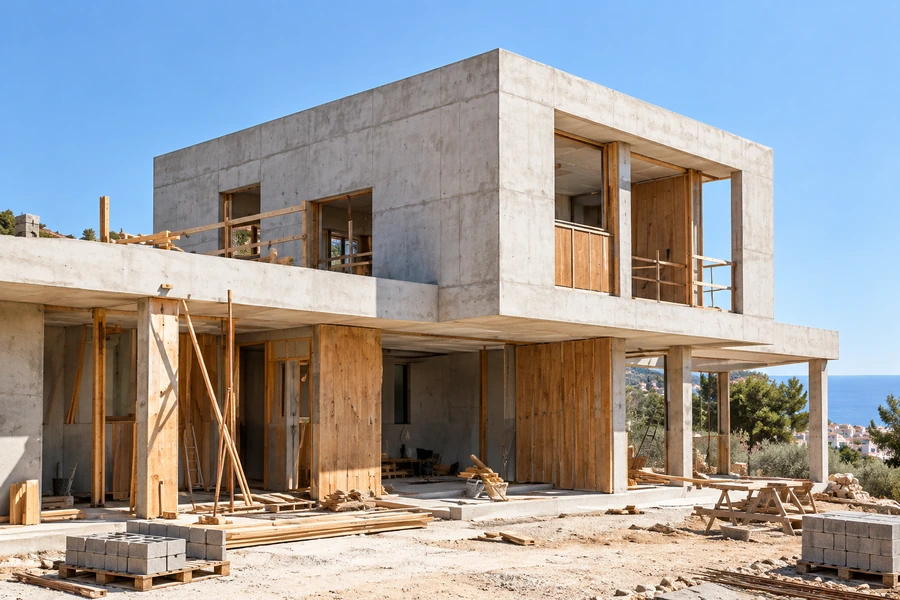
Build to rent in Spain means developing homes to retain and operate as rental accommodation. The investment needs to work after the construction team leaves: residents must choose it, rents must be collected and the building must be maintained. A projected rent multiplied by a unit count is only the top line of that business.
Begin with the operating model, then test whether the land, design, finance and legal framework support it. This reverses a common mistake: buying a development opportunity first and assuming that rental ownership will provide an easy fallback if individual sales become difficult.
Define the resident proposition before the building specification
Choose the intended household and use. Permanent homes, student accommodation and serviced stays can involve different demand, management and legal assumptions. The marketing label build to rent does not determine which rules apply to an actual contract or property.
Compare alternatives residents can really choose in the local area. Record asking rents separately from supported agreed rents, with dates, unit sizes, condition and included services. Consider the complete monthly burden, access to employment and transport, storage and parking. A city-wide headline does not establish willingness to pay for your specific building.
Use the development-feasibility assessment to connect that demand to a permitted scheme. The operating model should be revised if planning constraints change the mix or number of units. Do not preserve the financial result by quietly retaining homes that no longer fit the design.
Test the rental rules against the actual location
For residential leases within the relevant current regime, Spain's Urban Leases Act addresses duration, rent and operating obligations. Article 9 provides for mandatory renewals to five years, or seven where the landlord is a legal person, subject to the applicable conditions. A corporate landlord should model that contractual framework rather than assuming annual freedom to reprice or recover every home.
Initial rent and annual updates require separate review. In designated stressed residential markets, rules can depend on the declaration in force, landlord status and the property's rental history. Newly built or previously unlet homes should not simply be assumed outside every possible restriction.
Have the adviser identify the rules for the intended use, municipality and expected letting date. Record that conclusion in the model assumptions. If an exit involves selling occupied homes, review purchasing and transferring tenanted property so a sale scenario does not rely on unsupported vacant-possession assumptions.
Price ownership costs at the design stage
A durable finish is valuable when it can also be repaired economically. Review access to equipment, replacement components and the time needed to turn a home around between residents. A small saving during construction can be outweighed by repeated disruption later.
Ask the future operator to review cleaning routes, meter access, waste, deliveries and maintenance storage. Shared lounges, gardens or leisure facilities bring continuing costs; include staffing, utilities and upkeep before assigning them a rental premium. Evidence should support that premium in the local market.
The apartment-building budget should include commissioning, initial marketing and the work needed to open the building. Keep later replacement reserves distinct from routine repairs. Both consume cash, but at different times and for different purposes.
Establish the full investment and tax treatment
Total development investment includes land, acquisition costs, design, construction, equipment, permissions, development finance and initial letting costs. Define whether each line is gross or net of recoverable tax. An apparently comparable cost per square metre can omit several of these items.
AEAT explains that the letting of homes used exclusively as homes is VAT-exempt, within the scope and exceptions described. That does not make the VAT paid during development automatically recoverable. Deduction depends on the transactions and requirements of the VAT Act.
Mixed residential, commercial or service uses require their own assessment. Include identified irrecoverable VAT in cost and model the timing of any legitimately recoverable amounts separately. Coordinate this with the company ownership structure; using a company alone does not establish the tax outcome.
A twelve-home teaching model
Illustrative model prepared on 19 September 2026: twelve homes, assumed monthly rent of €1,100 each, total investment of €2.4 million and a stabilised year. These are invented teaching inputs, not Spanish market rents, building prices or promised returns. Assume combined vacancy and collection losses of 6%, annual operating expenses of €42,000 and debt service of €78,000.
| Annual line | Calculation | Amount |
|---|---|---|
| Potential rent | 12 × €1,100 × 12 | €158,400 |
| Vacancy and collection allowance | 6% of potential rent | €9,504 |
| Effective income | €158,400 − €9,504 | €148,896 |
| Operating result | €148,896 − €42,000 | €106,896 |
| Cash after debt service | €106,896 − €78,000 | €28,896 |
Here, operating expenses mean owner-paid management, ordinary repairs, insurance, property charges and common-area services. The operating result excludes debt service, profit tax and major replacements. It is not accounting net profit or the owner's spendable return.
The result divided by €2.4 million is about 4.45% on total cost for this model. It does not include an exit value or measure the return on equity. Set aside a further assumed €12,000 for replacements and cash falls to €16,896 before profit tax.
Change the assumptions that can break the plan
In a downside example, reduce monthly rent to €1,000, increase combined vacancy and collection losses to 10%, and raise operating expenses to €46,000. Effective income becomes €129,600 and the operating result €83,600. After the same €78,000 debt service and €12,000 reserve, cash is negative €6,400 before tax.
That is a sensitivity test, not a forecast. It shows how a margin can disappear when several assumptions move together. Test development overruns separately: a higher investment changes the return-on-cost denominator even if rent remains unchanged. Test the financing repayment profile rather than assuming every loan is interest-only forever.
Model the first letting period monthly as well. Some costs begin before the first resident arrives, and occupancy builds over time. A stabilised annual loss allowance is not a substitute for that opening cash plan. The development-finance strategy must bridge construction, initial letting and any proposed long-term refinance.
Choose a decision threshold you can defend
Record the evidence behind rent, achievable unit count, investment, owner expenses, tax treatment and funding. Mark what is confirmed and what still depends on a negotiation or approval. Agree the conditions under which the investment will be reduced, redesigned or declined.
During operation, compare collections, maintenance and resident turnover with those original assumptions. A good model remains useful after the investment decision because its definitions are clear. Share the municipality, proposed rental use, approximate unit count and land stage. Explain whether the aim is to develop, hold or sell the building so the next enquiry addresses the actual ownership plan.
Sources and further reading
- Ley de Arrendamientos Urbanos: duración, renta y gastos
- AEAT: IVA en el arrendamiento de vivienda
- Ley del IVA, artículos 3, 84, 90, 91 y 94
Sources checked on 19 September 2026. Your property documents and local requirements determine how the guidance applies to your project.