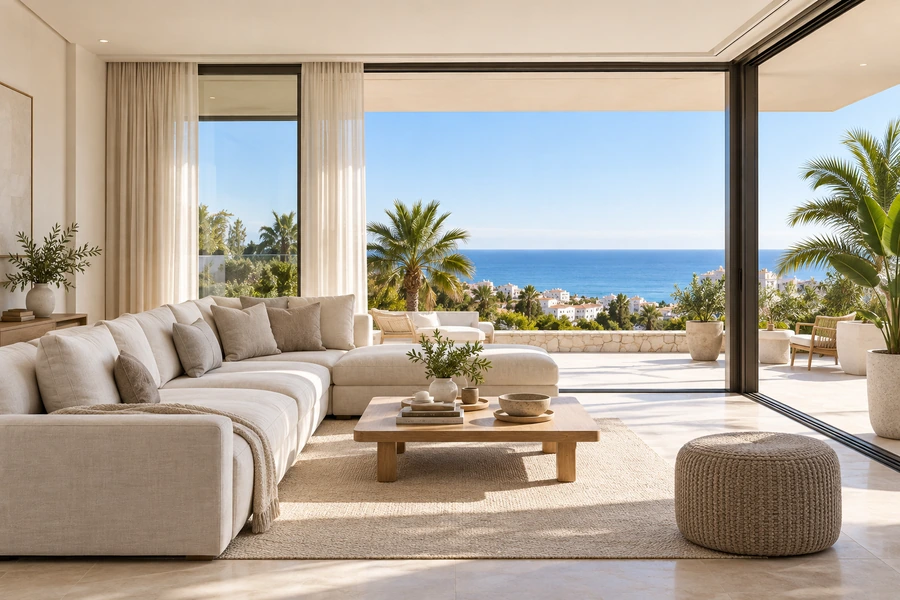
A sea view can dominate a viewing. It tells you much less about the weekly shop, an evening arrival or getting a leak attended to while you are abroad. Two homes on the Costa Blanca can offer a similar photograph and very different responsibilities. The right choice starts with the life you expect to lead there.
Dénia, Xàbia, Teulada-Moraira and Calp are useful reference points for a northern search; Guardamar, Torrevieja and Orihuela Costa help frame a southern one. Treat those labels as geographical orientation, not categories that determine every neighbourhood's prices, services or suitability.
Write your ordinary week before organising viewings
Decide whether the home will be occupied year-round, used for working visits or left empty between holidays. List the journeys you would actually make: groceries, healthcare, exercise and school where relevant. Check the specific services you need, rather than assuming a lively holiday street will support every part of your routine.
For occasional use, identify who could attend an urgent problem, admit a contractor or look after the property. A popular destination does not organise those arrangements for you. The Spanish home-buying guide helps turn your priorities into requirements that can filter the shortlist before you spend a trip on unsuitable homes.
Use landscape as a prompt for site checks
Searches around northern towns may feature hillside settings and coves, while southern searches also encounter open beaches, salt-lake landscapes and extensive residential developments. These broad images are not rules. Urban apartments and very different access arrangements exist within the same municipality, so inspect the actual address.
Where a home sits on a slope, test the pedestrian route, steps, driveway and outdoor levels. If you intend to build, consider the work categories explained in the sloping-plot budget guide. A flatter-looking location still needs attention to drainage and access. Neither picturesque elevation nor flat ground is a substitute for a proper assessment of the site.
| Your priority | Check at each shortlisted address |
|---|---|
| Everyday walking | Actual route, gradients, crossings and required services |
| Private outdoor space | Neighbouring views, boundaries and care arrangements |
| Long absences | Incident response and planned maintenance |
| Working from home | Address-specific connectivity, noise and usable space |
Test travel from the front door
Distance to an airport or town centre is only part of a journey. Check the road out of the development, parking and the last stretch on foot. If public transport matters, look up the current routes and timetable for the relevant stops. Being near a stop does not establish that its service fits your working hours or arrival time.
Where practical, make an important journey outside the sales appointment. Note what you observed and what remains unknown. An evening visit may raise questions about lighting or access, but a single impression should not become an unsupported conclusion about an area's safety. Two addresses in one town may differ more in daily convenience than two towns on opposite parts of the coast.
Compare ownership arrangements, not regional stereotypes
An apartment, townhouse and detached villa allocate work differently. For shared developments, examine the available community documents, services, expenditure and proposed works. For a house, identify responsibility for the garden, pool, roof and equipment. Include the practical cost of organising help when you are not present.
Separate historical bills from future commitments. A low previous charge does not prove low future maintenance, just as a freshly presented garden does not establish the condition of concealed building elements. Ask the same questions of each property. Otherwise an apparent north–south difference may simply reflect a comparison between unlike property types.
Investigate the particular land and surroundings
Build a basic pack containing property identification, mapped information and relevant planning documents. The guide to public plot maps explains how the sources differ. If a view, entrance or future extension is central to the purchase, commission the appropriate check rather than treating the listing plan as proof.
Consult available flood information for the address. MITECO's national mapping system is an official starting point, alongside applicable regional and municipal information. Use the flood-risk checks guide to prepare questions about the layer and coverage. A regional label, a small rise in ground level or an uncoloured map area cannot rule out every risk.
Make the trade-offs visible before choosing a favourite
Select a few criteria and weight them before scoring properties. Daily mobility, workspace, accessibility, upkeep and overall cost are possible choices. Keep a sentence explaining each score. The purpose is not to let an arithmetic total choose your home; it is to reveal the compromise that an attractive viewing may encourage you to ignore.
As an illustrative exercise, one household may put walking to groceries ahead of a private garden. Another may value outdoor space enough to organise driving and gardening support. Both can make sensible choices. Do not use unverified rental yields or expected price growth to compensate for a property that fails your intended use.
Return to the full budget and the actual address
Add the price, acquisition expenses, initial work and maintenance arrangements. Use the property purchase-cost calculator with the relevant details, keeping unconfirmed annual costs separate. If money must be converted from another currency, identify that planning uncertainty rather than silently fixing every future transfer at one rate.
The final decision is about a home you can buy and use on acceptable terms, not a winner in a north-versus-south contest. To organise the next shortlist, tell us about your search, the towns you are considering and the routines that matter most. Those details make it possible to compare real opportunities without repeating the same attractive holiday impressions.
Sources and further reading
- Turisme Comunitat Valenciana: Costa Blanca, Alicante
- MITECO: Sistema Nacional de Cartografía de Zonas Inundables
- Catastro: visor de cartografía
Sources checked on 22 September 2026. Your property documents and local requirements determine how the guidance applies to your project.