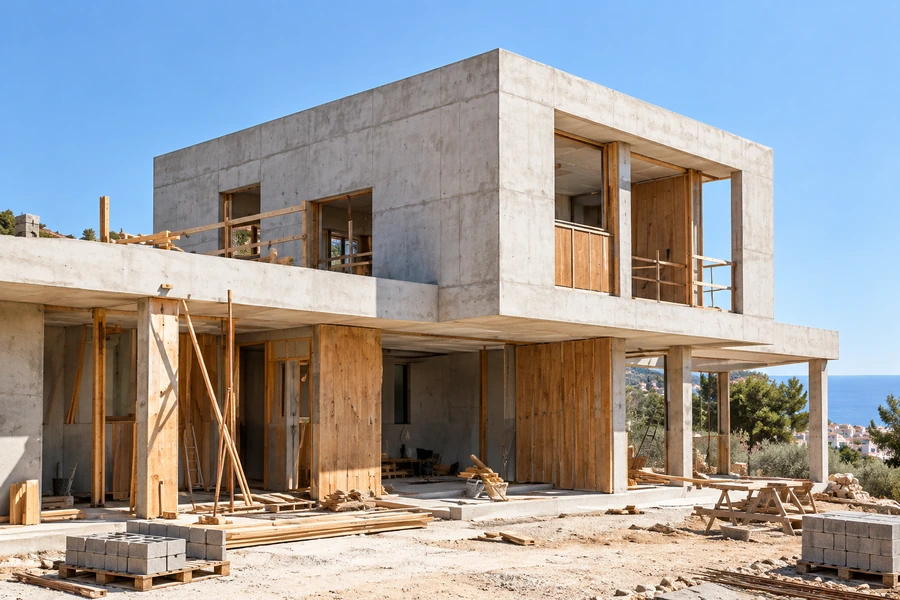
Being a self-builder in Spain does not automatically make decennial insurance irrelevant. There is a statutory exception for an individual self-promoter building a single family home for their own use, but the exact project must fit it. A later sale within the relevant period creates a further decision.
The best time to resolve the position is before construction and technical evidence are difficult to revisit. Treat it as part of the project setup, not simply a document to arrange when a buyer or notary asks for it several years later.
What seguro decenal actually addresses
The ten-year guarantee described in Spain's Building Act, article 19, concerns specified material damage arising from structural defects that directly compromise mechanical resistance and stability. The phrase is not shorthand for comprehensive cover for every fault in a new home.
A misaligned cabinet, failed appliance and structural movement require different analysis. The classification depends on cause and effect, not merely the age of the house. Home insurance, professional liability cover and construction-period insurance also serve different purposes.
Our article on new-build defects and warranties explains the wider picture. In particular, a period during which a type of defect may give rise to responsibility is different from the time allowed to pursue an action. Discovering a problem does not mean you can postpone all action until the building turns ten.
The self-builder exception is a defined case
The LOE's second additional provision establishes the residential guarantee requirement and the own-use, single-family self-promoter exception. All elements of the applicable case matter; the fact that you personally pay the builder is not enough by itself.
Multiple dwellings, a scheme intended for sale or a particular ownership structure require their own review. Have the notary or adviser examine the full facts before excluding the guarantee from your plan. Avoid importing assumptions from the new-home warranty system in your home country.
An exception from arranging this guarantee also does not eliminate construction requirements or every potential liability. Your house still needs an appropriate design, competent execution and records of control. Insurance decisions and technical quality are related, but one does not substitute for the other.
A sale can change what documentation is needed
For an inter vivos transfer within the relevant ten-year period, the statutory wording addresses cover for the remaining time, with an exception involving proof of the self-promoter's own use and the buyer's express release from providing the guarantee. The seller cannot simply declare that the buyer is deemed to agree.
Consider an illustrative situation: you build a home to live in, occupy it and decide to sell four years into the applicable period because your work takes you elsewhere. The issue is the remaining portion of that period, subject to the actual dates and legal facts, rather than automatically starting a new ten years at the sale.
Discuss the options before marketing on firm assumptions. The notary needs the relevant evidence, the buyer needs to understand any proposed release, and a lender may have its own conditions. A legally available route does not guarantee that every purchaser or bank will accept it.
The article on registering a newly built Spanish house explains the related property documentation. If you are buying from a developer instead, see our new-build purchase checks.
Technical inspection belongs early in the conversation
An insurer assesses the risk using the information and evidence required for its proposal. Establish those requirements before appointing inspection services or assuming that existing professional supervision will satisfy every underwriting condition.
An OCT, or technical control organisation, may form part of the insurer's requirements. Its role is separate from the statutory design and execution appointments. The relevant organisation, scope and reports need to be accepted for the proposed cover; the initials alone do not establish suitability.
Early planning matters because concealed construction stages are harder to examine retrospectively. If the house is already finished, the insurer may require additional evidence or investigations, and acceptance is not assured. It is better to identify that possibility before relying on a future sale to complete smoothly.
Compare the full insurance arrangement
| Item | What it tells you |
|---|---|
| Insured building and use | Whether the proposal matches the real project |
| Scope and sum insured | The defined risk and financial extent of protection |
| Inception and expiry | The period actually covered |
| Exclusions and excess | Limits and retained exposure |
| Inspection conditions | Reports and evidence required for acceptance |
| Premium and other charges | The total financial commitment |
| Final documentation | The evidence available to you and future parties |
The Insurance Contract Act, article 8, specifies policy information including the risk, cover, exclusions, sum insured, premium and duration. A preliminary quotation should not be mistaken for unconditional cover with every requirement already satisfied.
Separate the insurance premium from technical control, tests or reports charged by others. Record each in your whole-project budget. A percentage mentioned for another house is not a substitute for a proposal based on your project and chosen conditions.
Keep evidence that will still make sense in five years
Retain the project, approved changes, inspection records, identities of the construction agents and completion and receipt documents. Store the policy wording and evidence of the agreed cover with them. A future reader should be able to connect the paperwork to the building as actually completed.
The relevant commencement of a legal or insurance period must be determined from the proper documents. Do not automatically count from the first night you slept in the house or from whichever certificate is easiest to find. Reservations and subsequent corrections can make a casual calculation unreliable.
During builder selection, establish cooperation with the technical evidence and handover requirements. Documentation is part of delivering a usable project record, even when it is less visible than the finishes.
Frame the decision around your actual plan
Describe who is promoting the work, how many dwellings are involved, the intended use and the stage of construction. Include any realistic possibility of selling. Those facts allow the statutory position and available insurance arrangements to be examined together.
You can explain your self-build situation and whether you are planning, constructing or preparing to sell. Identifying the timing first helps focus on the documents and decisions still possible at that stage.
Sources and further reading
Sources checked on 19 September 2026. Your property documents and local requirements determine how the guidance applies to your project.