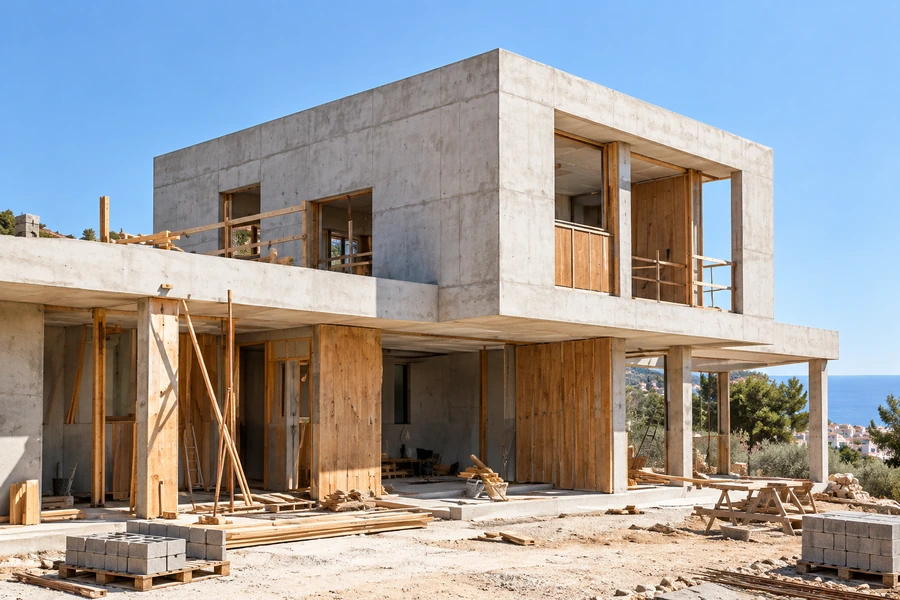
Buying a Spanish plot does not give you permission to start building, and paying a municipal charge does not substitute for the necessary approval. First establish what the plot permits, then prepare the appropriate application and satisfy the conditions for commencement.
English speakers often call the whole process planning permission. In Spain, the relevant municipal procedure, project documents and later occupation steps need to be identified separately. The useful question is not simply whether permission exists, but what exactly it authorises and what remains to be done.
Begin with written information about the plot
Ask your design team to confirm permitted use, building area, site coverage, height and setbacks for the identified parcel. If you are still negotiating its purchase, this information can change your decision long before you commission a detailed house design.
Use our guide to planning information for a Spanish plot to frame the request. A neighbour's house, an estate agent's sketch or a cadastral description does not establish that your proposed building will be authorised on the same terms.
The national Land and Urban Rehabilitation Act, article 11, addresses the administrative approval required for building acts. Your municipality and advisers must identify the procedure applicable to the actual project, including any regional or sector-specific requirements.
Know which design package is being submitted
A proyecto básico defines the general proposal for the approval stage. The proyecto de ejecución develops the technical information needed to construct it. The CTE expressly distinguishes these stages; the basic project alone is insufficient to start construction.
This distinction explains why receiving a planning-stage document from your architect may not mean the tender package is ready. Read our guide to building plans in Spain and agree when each stage is delivered, submitted and coordinated with the other required information.
Ask who acts as the applicant's representative and who monitors notifications. If you live abroad, the project should not depend on you noticing an unfamiliar message days after it arrives. Record the application number and keep access to the exact documents filed.
Organise the application around a document register
| Document group | What to establish |
|---|---|
| Applicant and site | Correct identities, representation and plot details |
| Technical project | Required drawings, reports and current revision |
| Supporting information | Studies, previous decisions and relevant external approvals |
| Financial documents | Applicable charges, deposits and payment evidence |
| Before commencement | Outstanding technical appointments, submissions and approval conditions |
| Tracking | Submission receipts, notifications and response deadlines |
The exact list comes from the current municipal procedure. A waterfront, heritage or road-access constraint may add another authority to the process. Ask which approvals are dependencies and which activities can proceed alongside them.
Keep a version register rather than a folder full of files called final. When a drawing is replaced, record its date and purpose. The builder should later receive the coordinated authorised design, not whichever PDF happens to be easiest to find.
Separate the licence fee from construction tax
The application or processing charge, usually described as a tasa, is different from ICIO, the tax on construction, installations and works. Other deposits may also be required. Ask for a payment schedule showing each concept and whether it is a final cost or potentially refundable security.
Under the Local Finances Act, articles 102 and 103, the municipality sets the ICIO rate subject to a 4% ceiling. Its statutory base concerns the material execution cost, with specified exclusions, rather than your entire land-and-building expenditure. An initial assessment can be reconciled after completion.
Illustration only: if the relevant base were €240,000 and a hypothetical local rate were 3%, the tax would be €7,200. That calculation does not tell you your municipality's rate, processing fee or available reliefs. Obtain those from the applicable local rules before budgeting the actual payment.
Include confirmed charges in your whole-project construction budget. Do not count an unapproved reduction as secured funding, and allow for any deposit that consumes cash before it can be returned.
Handle requests for information as a managed task
A council request for corrections is not necessarily a refusal. Identify each requested item, the responsible professional and the response deadline. Then submit a complete response and retain its receipt.
Spain's Administrative Procedure Act governs matters including correction of applications and notifications. Your appointed representative should explain which notification channel applies and how deadlines are tracked. A friendly email from a technician should not become the only record of the formal position.
For example, a request might concern both a missing drainage drawing and an inconsistency in the proposed ground level. Sending the drawing alone leaves the other issue unresolved. A response table linking every query to a revised document makes the file easier to follow for you and the design team.
Do not promise the builder a start date too soon
Keep the statutory decision period distinct from a project forecast. Additional information, external reports and changes to the proposal can affect the process. Ask what assumptions support the date in your programme and when they will next be reviewed.
Administrative silence is a legal question, not a practical shortcut to starting work. Have the applicable position confirmed rather than assuming that no reply means yes. A payment receipt or application acknowledgement should likewise not be presented to the contractor as a building approval.
Once the decision arrives, read its conditions, validity and commencement requirements. Check whether the execution project or other documents remain to be supplied. The article on building timelines shows how to place this gate in a wider schedule.
Make the commencement decision together
Before work begins, bring the approval, current project information and outstanding conditions into one review with the technical team. Establish who confirms each item and what document records it. Make sure the programme and contract refer to the same conditions for starting.
When comparing builders, discuss how a delayed approval changes mobilisation, procurement and payments. Clear prerequisites are easier to manage than an unconditional date selected before the application was assessed.
You can describe your plot and application stage, including the municipality and whether you have received any formal queries. That focuses the conversation on the approval step you need to resolve before committing further funds.
Sources and further reading
- BOE: Ley de Suelo y Rehabilitación Urbana
- BOE: Código Técnico de la Edificación, Parte I y anejos
- BOE: Ley Reguladora de las Haciendas Locales, ICIO
- BOE: Ley 39/2015 del Procedimiento Administrativo Común
Sources checked on 19 September 2026. Your property documents and local requirements determine how the guidance applies to your project.