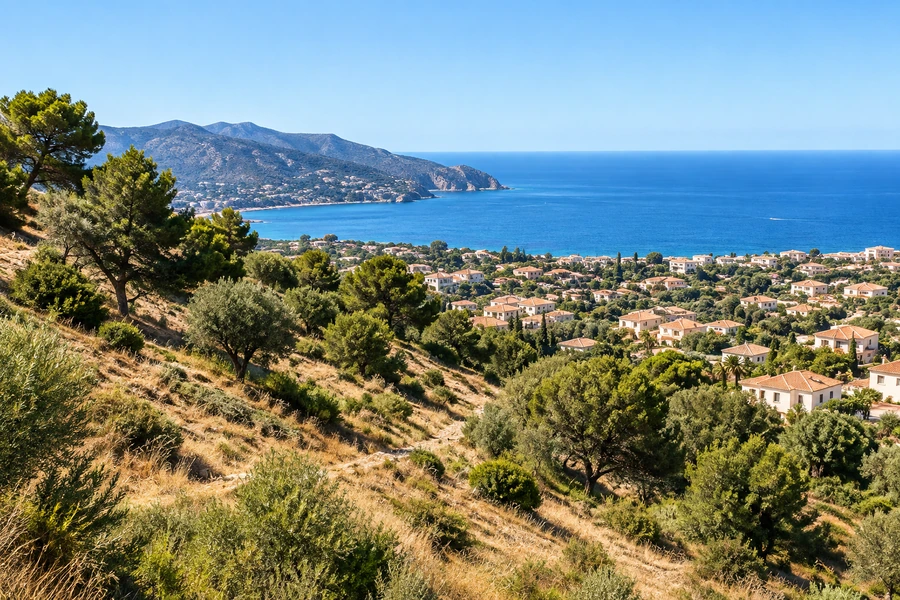
When comparing Spanish building plots, the asking price is only the first number. A cheaper hillside site may require substantial access and retaining works. A more expensive parcel may have fewer external works but still need utility connections. The useful comparison is the cost of reaching the same starting point for the same proposed home.
Define that starting point explicitly. “Ready for construction” might mean something different to an agent, a builder and a utility operator. Your budget should list the work included, the information supporting it and what remains unknown.
Use three budgets that connect
Keep acquisition, site preparation and house construction in separate sections, then combine them into the overall project total. Acquisition includes the price, applicable taxes, transaction expenses and advisers. Have the tax treatment checked for the actual land transaction and region; assumptions taken from a previous apartment purchase may not fit.
Site preparation covers the investigations and works needed before or alongside construction. House construction covers the building and its agreed specification. The complete house-building budget helps join these sections without losing design fees, approvals and other project expenses.
Work backwards from the total funds available. If you commit too much to the land, the missing money does not disappear; it usually becomes a smaller house, deferred external works or extra borrowing.
Separate outstanding development obligations from connections
Ask whether the plot carries obligations relating to a wider development area, unfinished streets or infrastructure. These are different from paying to connect your home to an existing service. Request the relevant documents and identify whether figures are final, provisional or still unassessed.
Article 18 of Spain's Land Law sets out duties associated with urban transformation. Your advisers need to establish how the applicable obligations affect the specific plot and proposed purchase. Do not assume they have all been discharged because neighbouring houses are occupied.
If several owners or public works influence progress, record that dependency alongside the cost. A project can remain financially plausible while failing your personal move-in timetable. Our urban and developable land guide explains the status questions to ask.
Utility budgets need a route, scope and capacity
Request written information from the relevant water, electricity and wastewater operators. A nearby connection is only part of the picture. You need to know the proposed connection point, available capacity, external works, permissions, charges and the work left for your own contractor.
Put the route on a plan. Long trenches, road crossings, reinstatement or another owner's land can change the scope. Ask how long any offer remains valid and which assumptions would require it to be revised.
Keep temporary construction services separate from permanent supply. If water must be brought in or temporary power arranged, assign responsibility and a duration assumption. A house quote may include neither, even when the builder has allowed for ordinary site work.
Price the route to the plot, not just the entrance
Ask the builder to examine delivery access. Narrow lanes, tight bends, limited turning space and overhead obstructions can affect equipment and methods. The issue becomes particularly important with prefabricated modules or large lifting operations.
Separate temporary protection and access works from the permanent driveway. Confirm whether reinstatement outside the site is included. If the route uses private land, have the legal access position checked as well as the practical construction route.
These questions should be settled while comparing plots or procurement approaches. Discovering them after ordering a building system can leave fewer affordable alternatives.
Groundworks need evidence before a firm allowance
Topography and geotechnical information help the designer assess excavation, foundations and retaining structures. A flat-looking plot is not proof of uniform ground, and a steep plot is not automatically uneconomic. What matters is the proposed design in relation to the site.
The Spanish Building Code's DB SE-C places geotechnical work early in the design process because it can influence structural choices. Read the site-survey guide before commissioning generic reports that may not answer your project's questions.
Ask the quotation to distinguish excavation, loading, transport, disposal or reuse arrangements and imported material. Where construction and demolition waste is involved, the framework in Royal Decree 105/2008 is relevant to the project's waste-management arrangements. The correct treatment depends on the material and circumstances; do not budget every removed load as an ordinary skip.
A simple comparison that exposes the hidden difference
This is a hypothetical exercise, not Spanish market pricing. Assume the preparation figures cover the same defined scope. Transaction taxes, professional acquisition costs and the house itself are not included in these subtotals.
| Illustrative item | Plot A | Plot B |
|---|---|---|
| Purchase price | €95,000 | €120,000 |
| Preparation and connections | €35,000 | €10,000 |
| Comparable subtotal | €130,000 | €130,000 |
The apparent €25,000 saving has disappeared. The next comparison is the quality of those numbers. A preliminary allowance based on photographs is less reliable than an offer tied to drawings, investigations and an agreed scope. Equal totals can therefore carry unequal risk.
Track certainty as carefully as euros
Give every budget line a status: confirmed offer, professional estimate, provisional allowance or unpriced. Add the responsible party, tax treatment, exclusions and expiry date. Keep significant unpriced work visible rather than burying it in a general contingency.
Check for overlaps when the building quotation arrives. Excavation, temporary services, connections and waste handling are common places for unclear boundaries between packages. The construction-quote comparison guide shows how to align offers before choosing a contractor.
Include the cost of waiting
Depending on your circumstances, the schedule can create loan interest, temporary accommodation, maintenance or repeated travel costs. Overseas buyers should also track the euro funding available if their savings or income are in another currency. These are individual budget inputs, not fixed percentages that can be copied from another project.
Obtain separate conditions for the electricity connection and water connection. A nearby network does not establish the approved route, required works or allocation of costs.
Before negotiating, identify the two or three unresolved items most capable of changing the decision and obtain better evidence for them. Tell us the preferred area, overall project budget and whether you already have a plot shortlist. A complete comparison starts with those constraints, rather than the lowest advertised land price.
Sources and further reading
- BOE · Ley de Suelo y Rehabilitación Urbana
- Código Técnico de la Edificación · DB SE-C Cimientos
- BOE · Real Decreto 105/2008, residuos de construcción y demolición
Sources checked on 19 September 2026. Your property documents and local requirements determine how the guidance applies to your project.