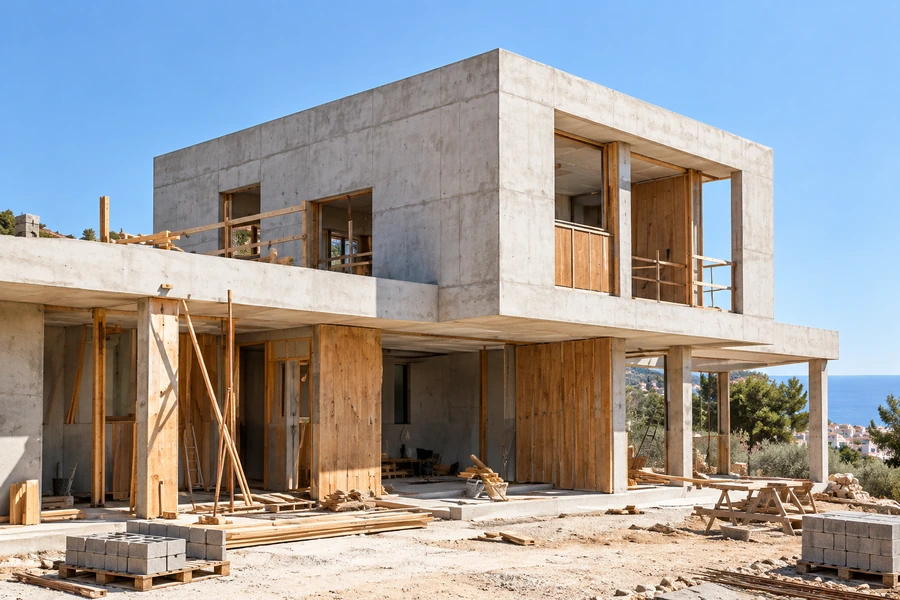
A builder's request for money should be understandable without guessing how much of the house looks finished. On a Spanish project, the supporting certification should connect the request to defined work and agreed valuation rules. The invoice and the bank payment then need to reconcile with that record.
This is particularly important when you manage from abroad. Photographs can show progress, but they cannot by themselves establish quantities, contract rates or whether an advance has already paid for part of the request. A clear document trail is more useful than a reassuring percentage.
Identify the document you have received
A contractor may send a proposed valuation, a certification ready for the relevant professional review, or an invoice. Those are related but different documents. Establish which one is being presented and which approval remains outstanding.
The LOE, articles 12 and 13, assigns functions concerning partial certifications to the works director and execution director. Your payment procedure should identify those roles and the separate person authorised to release funds for the owner.
The guide to your Spanish building team explains the professional names. Do not assume that a salesperson's approval, an architect's technical comment and your own consent to pay are interchangeable.
Read quantities cumulatively when that is the agreed method
A measured valuation usually links a description, unit, quantity and agreed rate. Where the document is cumulative, this month's amount comes from the increase since the previous certification, not from charging the whole completed quantity again.
Invented example: the contract contains 120 m² of a defined work item at €50/m². The previous certification recorded 40 m², while the present accepted cumulative quantity is 75 m². The new quantity is 35 m², valued at €1,750 under those hypothetical terms.
This is arithmetic, not a market quotation. The same measurement rule must be used in both periods. If openings, waste or ancillary work are treated differently, the item needs clarification rather than an unexplained adjustment.
Stored materials deserve their own treatment. Delivery to the plot is not necessarily completion of the installed work. Any payment for materials before installation should follow the agreed contract provisions and be tracked so the same value is not paid a second time later.
Work through the cash adjustments separately
The following is a hypothetical commercial reconciliation, before the correct tax treatment. It assumes an agreed advance-recovery arrangement and a contractual retention. Neither is presented as a universal rule for Spanish building contracts.
| Entry | Amount | Meaning |
|---|---|---|
| Current-period measured work | €23,000 | Increase over the previously certified quantity |
| Approved addition executed this period | €2,000 | Outside the first line, to avoid duplication |
| Value before cash adjustments | €25,000 | Supported by work and the approved change |
| Recovery of an earlier advance | −€5,000 | Reduces the advance balance under the agreement |
| Agreed retention for this example | −€1,250 | Held under specified release conditions |
| Commercial balance | €18,750 | Not automatically the VAT taxable amount |
An advance may already have produced a tax invoice, while a retention does not simply rewrite the value of the taxable work. VAT Act articles 75 and 78 address advance-payment accrual and the taxable amount. The invoice must apply the proper treatment rather than copy the final commercial balance. Our article on VAT on a Spanish self-build explains why each invoice type needs its own analysis.
Make variations traceable in both directions
A useful variation record identifies what changed, the agreed price, the programme effect and the owner's approval. When existing work is replaced, the valuation should also explain any omitted original scope. Recording additions while forgetting deductions can distort the final account.
For example, replacing one bathroom layout with another may add new pipework but remove some originally specified items. A net change calculation is easier to inspect than a list containing only the new purchases.
Civil Code article 1593 addresses a lump-sum building arrangement and authorised design changes in the circumstances it covers. Its application depends on the agreement and facts; a casual conversation should not become the only evidence of what extra work was authorised.
Handle a disputed line as a specific issue
If a line does not make sense, identify whether the disagreement concerns quantity, completion, rate, authorisation or arithmetic. Attach the relevant contract item and drawing reference. That gives the technical team and contractor something concrete to resolve.
Suppose a fitted item is claimed as complete but a component included in its description remains missing. The appropriate valuation follows the agreed rules and actual state, not just the fact that most of the item is visible. Record the position and issue corrected documents where required.
Follow the contractual notice and payment procedure promptly. Do not assume an unrestricted right to withhold any amount, or ignore the request until the deadline passes. Where the disagreement affects obligations or consequences, obtain advice on the actual contract before choosing a response.
Keep valuation, invoices and payments in separate registers
Previously certified does not necessarily mean previously paid. There may be an invoice awaiting settlement, a retention or an advance still to recover. Maintain records that distinguish work value, invoices, payments and outstanding adjustments.
A forecast of final cost also includes unfinished work and approved changes not yet certified. That is different from the amount currently due. Add the forecast to the whole-project budget so you can see whether the remaining funding will cover the remaining scope.
If a lender releases money in stages, its evidence and timing should be reconciled with the building contract. A contractor's payment date and a lender's release decision are not automatically aligned just because both refer to a construction stage.
Finish with a reconciled account
The final account should explain definitive quantities, additions, omissions, advance recovery and retention balances according to the agreement. It should be possible to follow the numbers from the original contract to the amount finally payable.
This economic close-out is different from the technical certificate of completion. One document does not silently resolve every issue belonging to the other. Keep outstanding work and document obligations visible through the agreed handover process.
Set the valuation procedure during builder selection, including who reviews requests and when payments become due. If you need to clarify an existing process, describe the stage-payment issue and whether it concerns quantities, changes or an advance. Identifying the disputed item and the reason for the difference gives the enquiry a useful starting point.
Sources and further reading
- BOE: Ley 38/1999 de Ordenación de la Edificación
- BOE: Código Civil, contrato de obra
- BOE: Ley 37/1992 del IVA, artículos 75 y 78
Sources checked on 19 September 2026. Your property documents and local requirements determine how the guidance applies to your project.