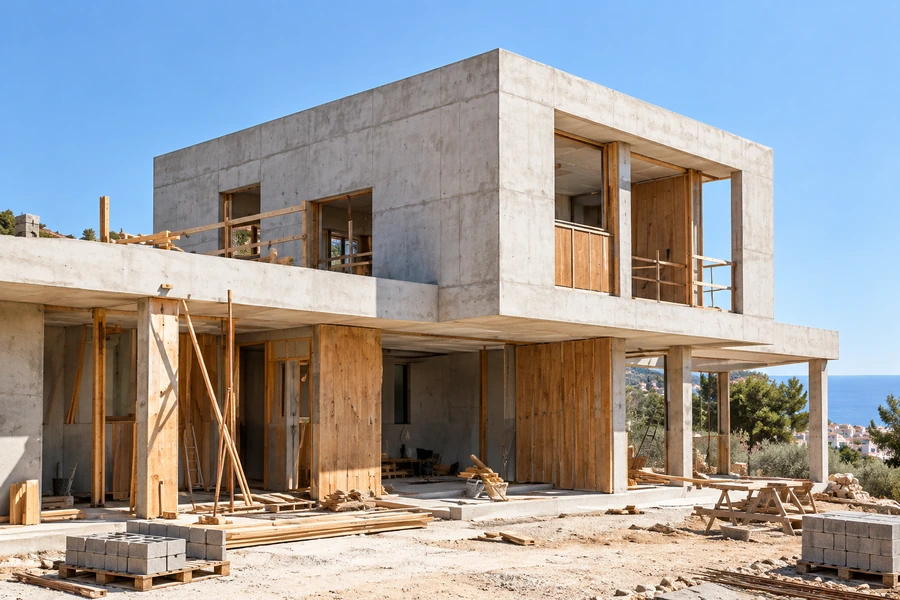
A Spanish quote headed hormigón armado may describe a completed reinforced concrete element, while a ready-mix supplier is pricing only the concrete delivered under stated conditions. The shared unit, euros per cubic metre, can make those very different offers look comparable.
The useful starting point is the element: footing, wall, column or slab. Its specification, reinforcement, formwork and placement method determine the scope. A single “concrete price” cannot represent all of them.
What published Spanish cost examples actually show
Two entries in CYPE’s Spanish new-build database, accessed on 19 September 2026, illustrate the distinction. Their totals are calculated direct costs for particular configurations, not contractor quotations or average prices across Spain.
| Database item | Selected configuration | Direct cost |
|---|---|---|
| CSZ010 footing | HA-25/F/20/XC2; truck placement; approximately 50 kg/m³ of B500S reinforcement. | €200.88/m³ |
| EHM010 wall | HA-25/F/20/XC2; about 50 kg/m³ B500S; 30 cm thick, up to 3 m; two-sided forms; bucket placement; complex conditions; finish for covering. | €338.44/m³ |
CYPE identifies its published reference project as a 2,200 m² apartment building with six above-ground storeys and one below ground. Project parameters and item selections influence the calculation. A detached house with difficult access is not automatically represented by those assumptions.
Read “direct cost” carefully: it is not an all-inclusive customer invoice with taxes, commercial margin and every adjoining site operation. These figures are useful because they expose scope, not because they predict your final bill.
Read the quantities before the unit rates
The wall entry includes ready-mix as a material input at €92.20/m³. Its allowance is 1.05 m³ of supplied concrete per theoretical cubic metre of wall, producing a concrete-material line of €96.81. Other resources take the completed unit to the higher total above.
This database input is not a supplier’s delivered offer for your plot. An actual order needs the specified mix, quantity, delivery location, discharge conditions and any additional charges. The material rate alone does not confirm that a placing crew or suitable equipment is included.
Also establish the measurement basis. The geometrical volume shown on drawings and the amount delivered can differ. Your agreement should explain which quantity is payable and how variations are evidenced, instead of leaving that question until the delivery notes arrive.
The building-material quotation guide is useful when reconciling suppliers who use different units or place transport and handling on separate lines.
Reinforcement is more than the weight of bars
Reinforced concrete combines materials with complementary structural roles. Concrete is strong in compression, while steel is arranged to contribute where the design requires it, including tensile zones. The designer determines reinforcement and detailing for the actual element and its conditions.
Spain’s official guide to the Structural Code for reinforced concrete buildings connects design, execution and control. A price comparison cannot justify changing the specified reinforcement or concrete without the required technical assessment.
For budgeting, distinguish raw steel supply from fabricated and installed reinforcement. Cutting, bending, transport, positioning, tying and spacers all belong somewhere. A low price per kilogram may stop at the merchant’s yard; another may include work on site.
The steel quantities in the database examples identify those selected items. They are not design allowances to copy into your own foundations or walls. Obtain quantities from the relevant project information rather than using a generic ratio as a construction instruction.
Formwork makes geometry financially important
Encofrado means formwork: the temporary arrangement that shapes and supports the concrete during construction. Its contact area, height, geometry and required finish affect the work. These variables do not increase in direct proportion to concrete volume.
A wall can have a large formed surface relative to its volume. Openings, changes in direction and a visible architectural finish introduce different demands from a simple concealed element. That is why “same concrete grade” does not mean “same installed rate”.
Foundation items have their own boundaries. Excavation, ground preparation and blinding should not be assumed from a footing heading. Use the foundation cost guide to place the structural item within the work below the building.
For a larger development, keep the quantities aligned with the apartment-building budget. A revision to the structural design should reach every bidder before you compare totals.
Placement logistics can outweigh a small material saving
Truck discharge, bucket placement and pumping are different arrangements. The suitable method depends on the project and site access. An offer should identify its assumption and explain who provides the necessary equipment and labour.
A fixed attendance charge has a different effect on a small pour. In a purely hypothetical example, a €500 fixed service adds €100/m³ when spread over 5 m³, but €25/m³ over 20 m³. Those invented figures demonstrate arithmetic, not Spanish pump-hire rates.
Do not turn that arithmetic into a reason to change the pour sequence independently. Construction joints, timing and execution belong to the technical plan. Delivery scheduling must fit that plan rather than setting it.
Allow responsibility for the work after placement as well. Curing, protection and the agreed control records are part of completing the element; the final truck leaving is not the same milestone as acceptance.
Convert the quotation into a decision
Multiply each resource by its own quantity before adding costs: concrete volume, reinforcement mass, formwork area and any separately priced equipment or labour. Adding €/m³ directly to €/kg or €/m² produces a meaningless total.
Your Spanish construction documents should identify the specified elements and measurement basis. Compare offers against that common information, then make exclusions, taxes and commercial terms visible alongside the technical scope.
Describe the concrete work you are planning, including the municipality, element type, available drawings and access constraints. State whether you need ready-mix supply or a completed reinforced concrete package so the enquiry starts with the right unit.
Sources and further reading
- CYPE España CSZ010: zapata de hormigón armado
- CYPE España EHM010: muro de hormigón
- CYPE España: parámetros de la obra de referencia
- CTE: guía de aplicación del Código Estructural, hormigón armado
Sources checked on 19 September 2026. Your property documents and local requirements determine how the guidance applies to your project.