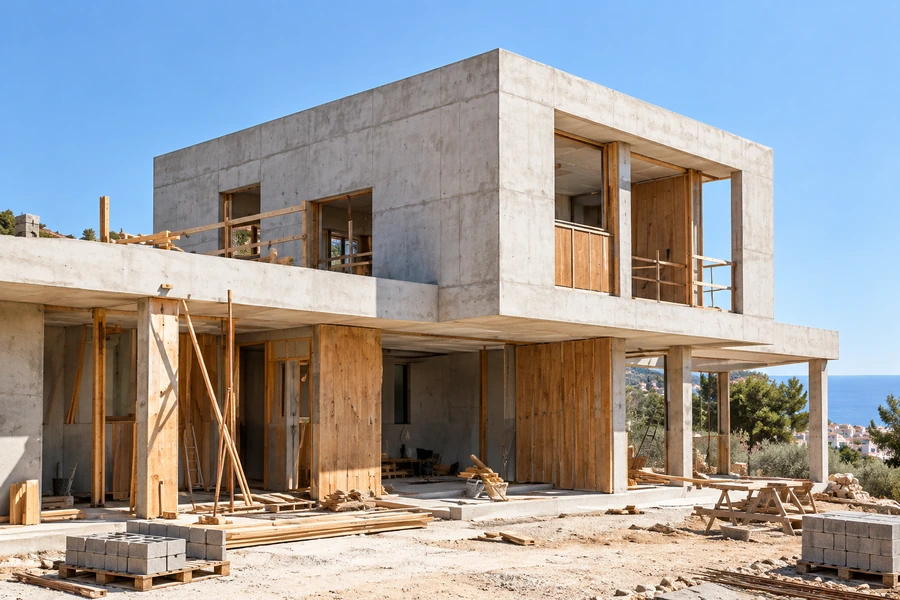
A beautifully finished show home can make a prefab purchase feel similar to ordering a product. Your Spanish building plot changes that picture. Foundations, access, planning, utility connections and local completion work still need to fit the design and the supply contract.
The right comparison is between complete routes to the same home. An industrialised method may suit your project well, but its benefits depend on the site, specification and coordination. Equally, a conventional build should be assessed on its actual organisation rather than assumed to be slower or more flexible in every case.
Ask the supplier to describe what leaves the factory
Modular often means three-dimensional units assembled off site. Prefabricated can also describe panels, frames or other manufactured components completed at the plot. A conventional house may contain many factory-made elements. These labels overlap, so request a description of the proposed system instead of relying on the category.
Find out what is already finished at dispatch: structure only, weatherproof shell, internal services, bathrooms or most finishes. Then list everything done after arrival. This helps you see which promises depend on the manufacturer and which rely on a separate local contractor.
Structure is another choice. Our articles on steel-frame homes and timber construction examine questions that remain relevant whether components are assembled in a factory or on the site.
A transportable home still needs a lawful location
Do not buy a cheap rural plot on the assumption that a movable or factory-built home bypasses planning. Spain's Land and Urban Rehabilitation Act, article 11, explicitly addresses prefabricated homes. Confirm the applicable requirements with the municipality and your project team for the precise proposed use.
Send them the actual model, footprint and intended occupation. You need an answer about your permanent residence or other defined use, not a general conversation about temporary structures. The guide to building on rustic land in Spain explains why regional and local checks come before assumptions about what a plot can host.
Check the last kilometre of delivery
A supplier's standard transport allowance may not reflect your approach road. Ask for a route assessment covering tight bends, gradients, overhead constraints, unloading space and lifting position. Establish who arranges any permissions or temporary works needed for the delivery.
Also identify what the site must look like when the truck arrives. Are foundations complete and accepted? Is the crane position prepared? Who pays if installation cannot proceed? These details belong in the scope and programme before you place an order.
For a panelised system, the delivery challenges may differ from those of large volumetric modules. Ask the supplier to explain its specific requirements. Do not assume every prefab home has the same logistics, just as conventional construction does not always need the same machinery.
Compare a finished-home scope
| Item | Question for every bidder |
|---|---|
| Design | Who adapts the home to the plot and supplies the required project documents? |
| Ground and foundations | What is included, what remains provisional and who accepts the support before installation? |
| Delivery and assembly | Are transport, lifting, labour and weather protection covered? |
| Building services | Who joins, tests and commissions the completed systems? |
| Finishes | Which fittings and external works remain after the main installation? |
| Handover | Who supplies documentation, resolves defects and coordinates outstanding work? |
Include taxes explicitly and request a full exclusions schedule. If foundations are a separate contract, bring both contractors into the technical discussion. A gap between their responsibilities can cost time even when each individual package appears well defined.
Separate installation time from project duration
Ask for the full programme: design freeze, approvals, procurement, factory production, site preparation, installation, connections and completion. Some stages can overlap, but only if their dependencies are coordinated. A short installation sequence is not a promise that you can move in immediately afterwards.
Make the decision deadlines visible. In a factory process, changing a window after components have been manufactured can have consequences beyond the price of the window. Ask which selections must be settled before production and what changes remain possible later.
For a conventional build, ask the same questions about long-lead purchases and site sequencing. The useful distinction is how the specific contractor manages dependencies, rather than an assumption that one method has no uncertainty.
Understand when you pay and what you own
Industrialised construction may involve payments while significant work remains away from the plot. Before signing, ask how progress is verified, how your components are identified and what the contract says about ownership and risk. Have the arrangements reviewed against your proposed funding.
If a lender is involved, confirm its conditions before accepting the supplier's payment calendar. Do not assume a finance product familiar from another country will release funds against exactly the same milestones. Currency transfers and your own travel schedule also belong in the plan.
Our guide to choosing a builder in Spain provides a framework for comparing payment terms and responsibilities alongside price.
Choose comfort and maintenance standards explicitly
Request the wall, roof and floor specifications, window details, shading strategy and ventilation proposal. Ask how joints between manufactured elements will be inspected. A good sample component does not answer every question about the assembled building.
Then consider ownership: access to concealed services, replacement components, exterior maintenance and the location of aftercare support. If the factory is distant, ask which business attends site when a problem needs physical investigation. Record the answer alongside the warranty documents.
Use your constraints to narrow the choice
A defined design and accessible plot can make an industrialised offer attractive to investigate. An unusual site or a brief that is still changing may require more adaptation. Neither observation decides the answer; it tells you which questions should be resolved before comparing totals.
Give shortlisted suppliers the same brief, site information and required finish level. Ask each to identify the largest remaining uncertainty. You can then weigh flexibility, coordination, cost and timing with evidence specific to the house you plan to build.
For a panel-based proposal, establish whether it is a SIP building system and where the supplier’s scope ends. Place factory production and assembly within the whole house-building timeline, including the work needed before and after delivery.
To start that comparison, tell us about your home and plot, including access restrictions, preferred construction method and whether you already have a design. A clear account of the site is more useful than a catalogue model name on its own.
Sources and further reading
Sources checked on 19 September 2026. Your property documents and local requirements determine how the guidance applies to your project.