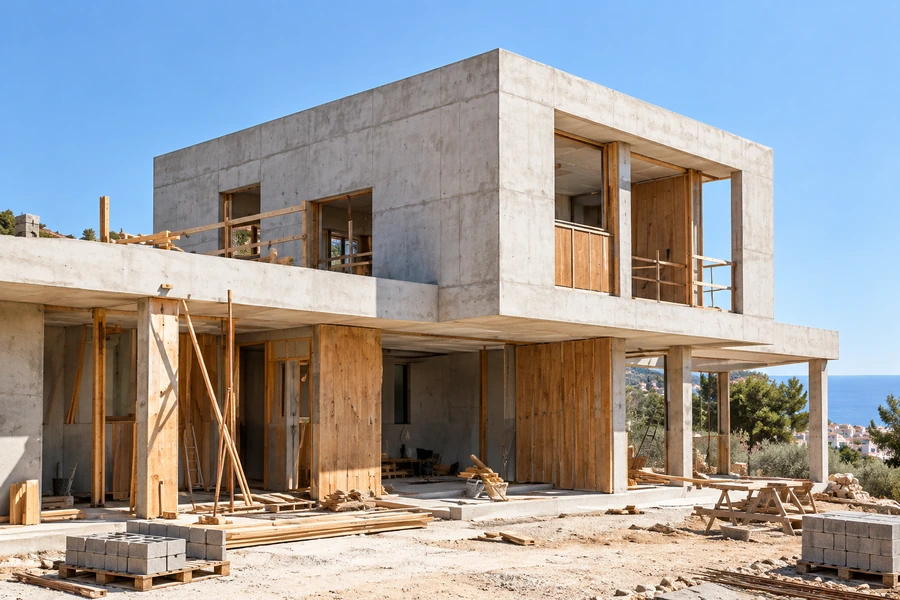
For an international buyer, the attraction of a turnkey house in Spain is simple: one organised route from an idea to a finished home. The difficult part is deciding where that route ends. A building can look complete while utility activation, external works or owner-supplied equipment remain outstanding.
Read a turnkey proposal as a defined scope attached to a defined site. The contract, drawings, specification and commercial promises need to describe the same result. A headline price becomes useful only when you can identify the obligations inside it and the essential costs outside it.
Establish which transaction you are entering
Commissioning a builder to construct on land you already own is different from purchasing a house and plot from a developer. The parties, documents, payments and responsibilities need to match the actual arrangement. The English word “turnkey” does not resolve those differences.
For a construction package, identify the contracting company and the named professional services it is arranging. One commercial contact can simplify communication, but does not erase the separate technical roles involved in a Spanish building project.
If the proposal has English and Spanish versions, reconcile defined terms, quantities and exclusions before signature. An English sales brochure describing a fitted kitchen and a Spanish schedule listing only kitchen service points should trigger clarification, not an assumption that both mean the same thing.
Preserve the promises that led you to choose the home
Keep dated brochures, correspondence, specifications and the relevant offer. In a consumer relationship, article 61 of Spain's consumer legislation gives contractual relevance to offer and advertising content even when it is not expressly reproduced in the signed document. Do not assume an exclusion automatically cancels an earlier promise.
Resolving discrepancies before signing is usually much easier than arguing about them later. Identify the version of every drawing and schedule incorporated into the agreement. “Latest plan” is ambiguous once several people are exchanging revisions across email and messaging apps.
A photograph can also contain styling that needs explicit treatment: furniture, curtains, exterior planting or a swimming pool. Establish the promised deliverables without treating all imagery as either automatically included or legally irrelevant.
Build a boundary map around the quoted package
The following is a comparison tool, not a list of items that every Spanish turnkey seller must include. An exclusion is manageable when its consequence, responsible party and cost are understood.
| Scope | If included | If separately arranged | Boundary to settle |
|---|---|---|---|
| Design and professional services | Named appointments and deliverables | Separate fees and coordination | Whether construction-stage services continue to completion |
| Site preparation | Work tied to site information | Another priced work package | Excavation, disposal, retaining walls and access |
| Foundations | The project-specific solution | A separately defined contract | Any unresolved ground assumptions |
| Utilities | Specified works and applications | Third-party charges identified | Installed pipework versus operational service |
| Kitchen and bathrooms | Models, quantities and fitting | Owner supply with agreed interfaces | Appliances, worktops, connections and finishing |
| External areas | Drawn surfaces and elements | A separately budgeted phase | Drainage, gates, terraces and safe access |
Move every essential exclusion into your complete Spanish house-building budget. Excluding an item from the main agreement does not remove the need to fund it.
The site must support the fixed-price assumptions
A standard house design and a site-specific construction obligation are different things. A sloping plot may need retaining structures, different access arrangements or a foundation solution that the initial model price never described.
Consider a fictional offer based on a level building platform. Your plot falls away towards the road, and the proposed terrace needs support. The useful decision is whether that support has been designed, included and assigned to a contractor. Debating the marketing label will not tell you who pays for it.
Where information is still missing, the agreement should explain the uncertainty and the procedure for resolving it. A vague groundworks allowance is not equivalent to a complete foundation package based on the relevant studies and project.
This applies across modular, prefabricated and traditional construction. Off-site manufacturing does not automatically include the crane, delivery access, on-site assembly or external works. Those interfaces still require explicit allocation.
Connect the equipment, the services and the handover date
A house may contain installed electrical circuits without a permanent electricity supply. Separate internal installation, works beyond the building, applications, third-party charges, testing and activation. Water and drainage need the same clear allocation.
For an owner living abroad, a precise responsibility schedule is particularly helpful. It distinguishes the person submitting an application from the body deciding it, and identifies who follows up if documents are missing. A builder cannot guarantee an independent authority's decision simply by offering to handle paperwork.
Temporary site supplies also need an owner and a payment arrangement. Their existence during construction does not prove permanent service is ready. Any dependency affecting practical occupation should be visible in the programme and handover requirements.
Define the total price and control substitutions
Consumer-law articles 20 and 60 address total-price and additional-cost information. Distinguish the seller's contractual price from taxes, fees and separately commissioned services payable elsewhere. Every known cost should have a place; unresolved amounts need an understandable calculation basis.
Use this scope map when comparing Spanish building quotations. A lower headline figure with unpriced essential work is not yet a complete alternative. Agreed changes should record additions, omissions, timing and approval, allowing the final account to remain traceable.
A substitution clause also needs substance. An alternative window can differ in opening pattern, thermal performance, dimensions or maintenance even when its price is similar. A heating unit can require different electrical capacity or space. Technical suitability and your commercial approval address different questions.
Require the proposed differences and consequences to be presented before the change is committed. The contract should explain the process for unavailable products, owner upgrades and resulting price adjustments. Avoid accepting “equivalent quality” as the only description of a replacement.
Describe completion before making it a payment trigger
Define what must be finished, tested and delivered when the home is handed over. Under the Building Act, or LOE, formal receipt of the works and the documentation of the completed building have specific roles. Keys alone do not describe the condition of the work or any recorded reservations.
The Spanish final works certificate is also distinct from the separate requirements for lawful occupation and use. The agreement should allocate remaining procedures rather than leave them under a general promise to “assist”.
Align the stage-payment process with identifiable work and documents. If a payment is linked to completion, both sides should be able to determine whether that contractual event has occurred.
Before committing, assemble one coherent offer pack with drawings, specification, exclusions and responsibility schedule. If you are deciding between packages, tell us your intended location and the scope offered. That provides a practical starting point for clarifying what your finished home still needs.
Sources and further reading
- BOE: Ley General para la Defensa de los Consumidores y Usuarios
- BOE: Ley 38/1999 de Ordenación de la Edificación
Sources checked on 19 September 2026. Your property documents and local requirements determine how the guidance applies to your project.